Bulk actions on users
Apply an action to many users at once without editing them one by one. You can act on selected users or on everyone matching the current filters.
Before you start
- You must be an admin for the current school.
- Some actions (e.g. QR codes, Google sync) are only visible when the school has the relevant feature enabled.
Steps
Step 1: Open the Users page
Select Users in the left sidebar.
Step 2: Select users
Tick the checkbox at the left of each row to select individual users.
To select all users matching the current filters, tick the checkbox in the header row. A banner appears asking whether to select just the current page or all matching users.
Step 3: Open the bulk-actions menu
An action bar appears at the bottom of the page showing how many users are selected and a set of action menus.
Step 4: Choose an action
Action menus are grouped by category. Select a menu to expand its options:
Google actions (if Google Workspace is enabled)
- Add to sync queue
- Approve / Disapprove classroom guardians
Entra actions (if Entra is enabled)
- Add to sync queue
Status
- Set to Active
- Set to Suspended
- Set Smartsync on / off
- Lock / Unlock usernames — see Locking usernames below
- Remove pending suspension
Add to group Opens a panel where you search for a group and add all selected users to it.
QR codes (if enabled)
- Print QR codes
- Generate QR codes
- Delete and regenerate QR codes
- Delete QR codes
See QR code login for what this menu does, how to turn it on, and the full generate → print → distribute workflow (including what to do if a pupil loses their code).
Password actions
- Reset to default
- Enable / Disable 2FA
- Reset 2FA secret (users re-enrol their authenticator app)
- Force change at next login / clear force-change
- Disable / Enable password reset for teachers
- Disable / Enable password change for students
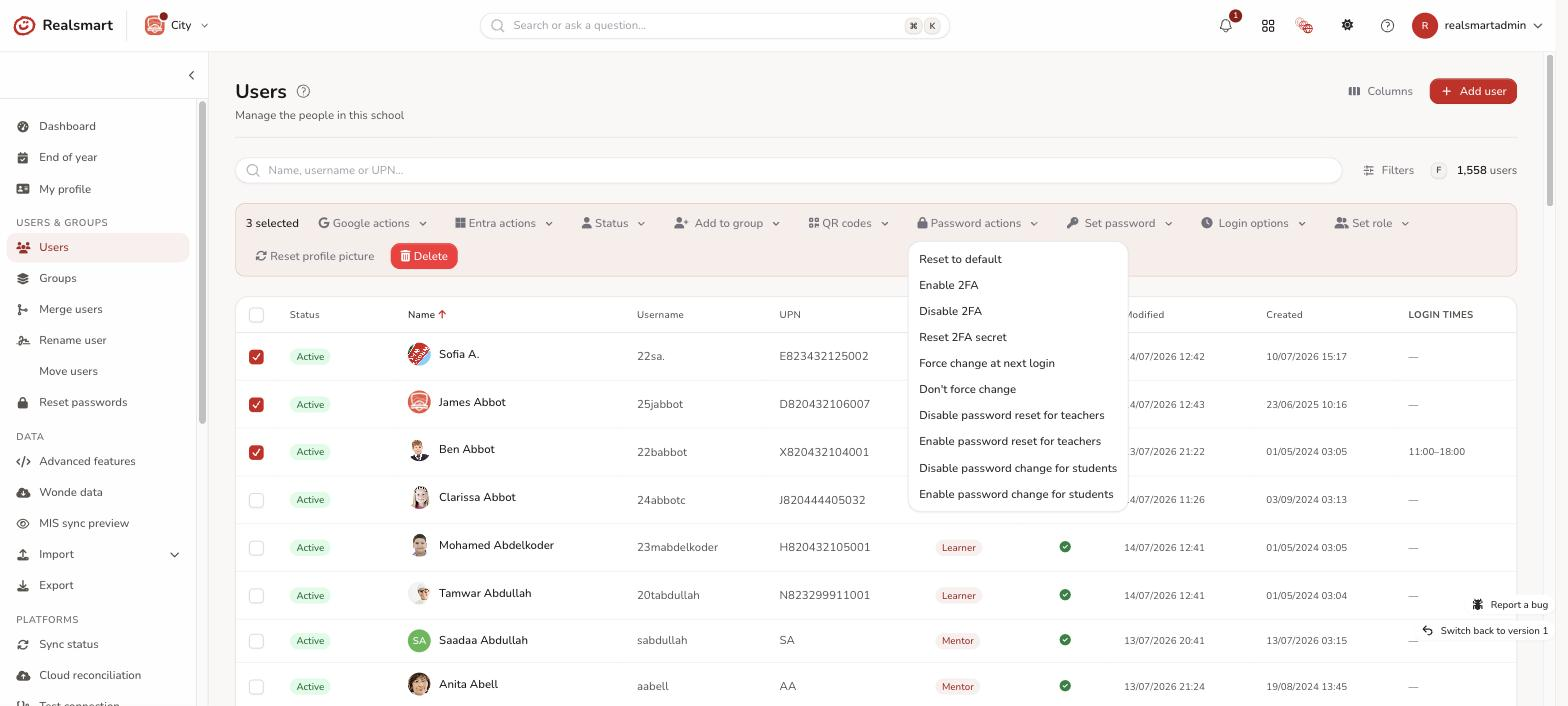
Set password Sets the same specific password on every selected user (as opposed to Reset to default, which uses each role's school default). Open the panel, type the new password, and apply — a confirmation states how many accounts will change and warns that each user's current password stops working immediately (pupils included), so check the selection first. It uses the same secure storage and validation as setting a password on one user's edit page, and — where password sync is enabled — pushes to their linked Google or Active Directory account on the next sync. The password is never shown in the audit log.
Login options Restrict when the selected users can log in. Enter both times in school local time — an overnight window (start after end) is allowed. Both times are required to set a window; an empty save never silently clears one.
The same dropdown has Don't allow login, which stops the selected users signing in to Realsmart at any hour of the day. It affects Realsmart sign-in only: their Google, Microsoft, Apple and Active Directory accounts are left exactly as they are, so this is not a way to suspend or delete an account. Use Allow login at any time to remove a window or a block and put the users back to unrestricted access.
The same settings are available for one user at a time on their edit page (Security → Login window).
Set role Change all selected users to Admin, Mentor, or Learner.
Reset profile picture Clears profile pictures for selected users.
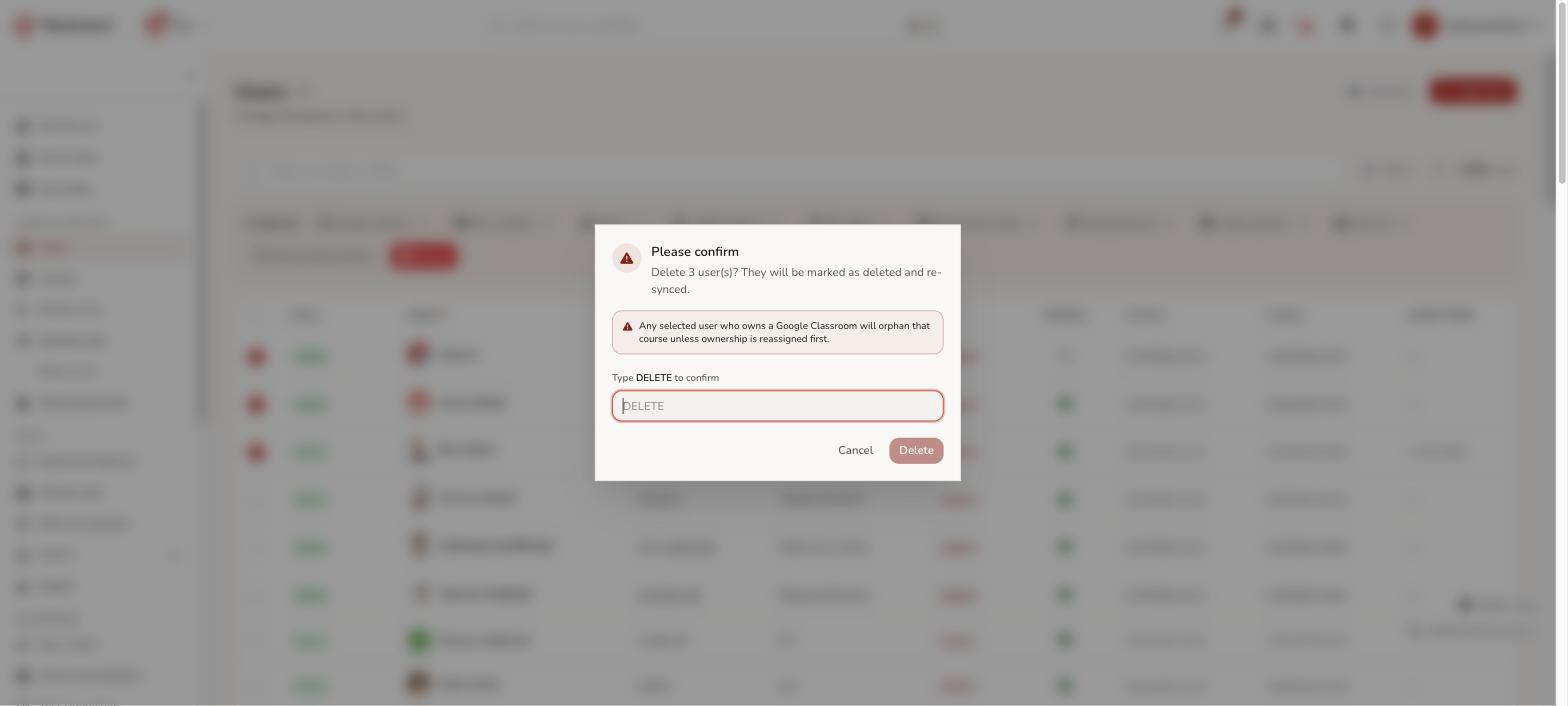
Delete Soft-deletes all selected users. They are marked Deleted and re-synced.
Step 5: Confirm if prompted
Destructive actions (delete, reset passwords, etc.) show a confirmation dialog. Read it carefully and confirm.
Delete goes further than a simple confirmation: you must type to confirm before it proceeds, and the dialog carries a warning — any selected user who owns a Google Classroom will orphan that course unless ownership is reassigned first. Check your selection for teachers who own classes before confirming.
Locking usernames
Lock usernames fixes each selected user's username so future imports never regenerate it. Unlock usernames puts it back under the username policy.
Users who still have a placeholder username — one starting with TMP_, meaning no real username could be generated for them yet — are skipped when you lock, and the message tells you how many were skipped. This is deliberate: a placeholder that is also locked can never be replaced, and a placeholder is excluded from every platform sync, so the user would be left with no working account and no way to get one.
If some of your selection was skipped, find those users with the Username state → Placeholder (not yet generated) filter, fix what is blocking them (most often a missing year group), and let the next import generate their real username before locking.
Unlocking is never restricted. If you have users stuck on a locked placeholder from before this safeguard, find them with Username state → Placeholder and locked (stuck) and unlock them.
Result
The action is applied to all selected users. A success message confirms how many users were updated.
Tips
- Apply filters first to narrow the list, then "select all" to act on a specific subset (e.g. all suspended learners, all users not in a group).
- Use Status → Set to Active after importing a batch of users to activate them.
Related
Did this work for you?
If a step looked different on your site, tell us and we'll update the screenshots.
Thanks for your feedback.