Merge history and undo
Merge history is the record of every user merge you've run, and the place to undo one if it turns out to be a mistake. The same page works in two contexts — reachable from a specific school (Users & Groups → Merge history) or from MAT overview (Merge history in the MAT sidebar) — showing the merges you can access in each.
Before you start
- You must be an admin. Mentors and other staff cannot view or undo merges.
- In a single school you see merges whose kept (primary) account is in that school; in MAT mode you see them across every school you're authorised for, plus any merge you personally started.
- Undoing a merge is best-effort, not guaranteed. It reverses the database changes and can attempt to recreate cloud accounts, but if the original merge deleted or suspended a Google or Entra account, that cloud action may not be fully reversible. Read the result screen carefully after an undo.
Steps
Step 1: Open Merge history
In the left sidebar, under Users & Groups, select Merge history. (The same page is available in MAT mode, listing merges across your authorised schools.)
Step 2: Browse the list
Each row shows:
- When the merge was run
- Primary — the account that was kept (by ID)
- Secondaries — how many accounts were removed into it
- DB status — whether the database change completed, or has since been rolled back
- Undo status — whether an undo has been run, is partial, or hasn't been started
Select View on any row to see its full detail, or Undo if the merge is eligible (see Step 4).
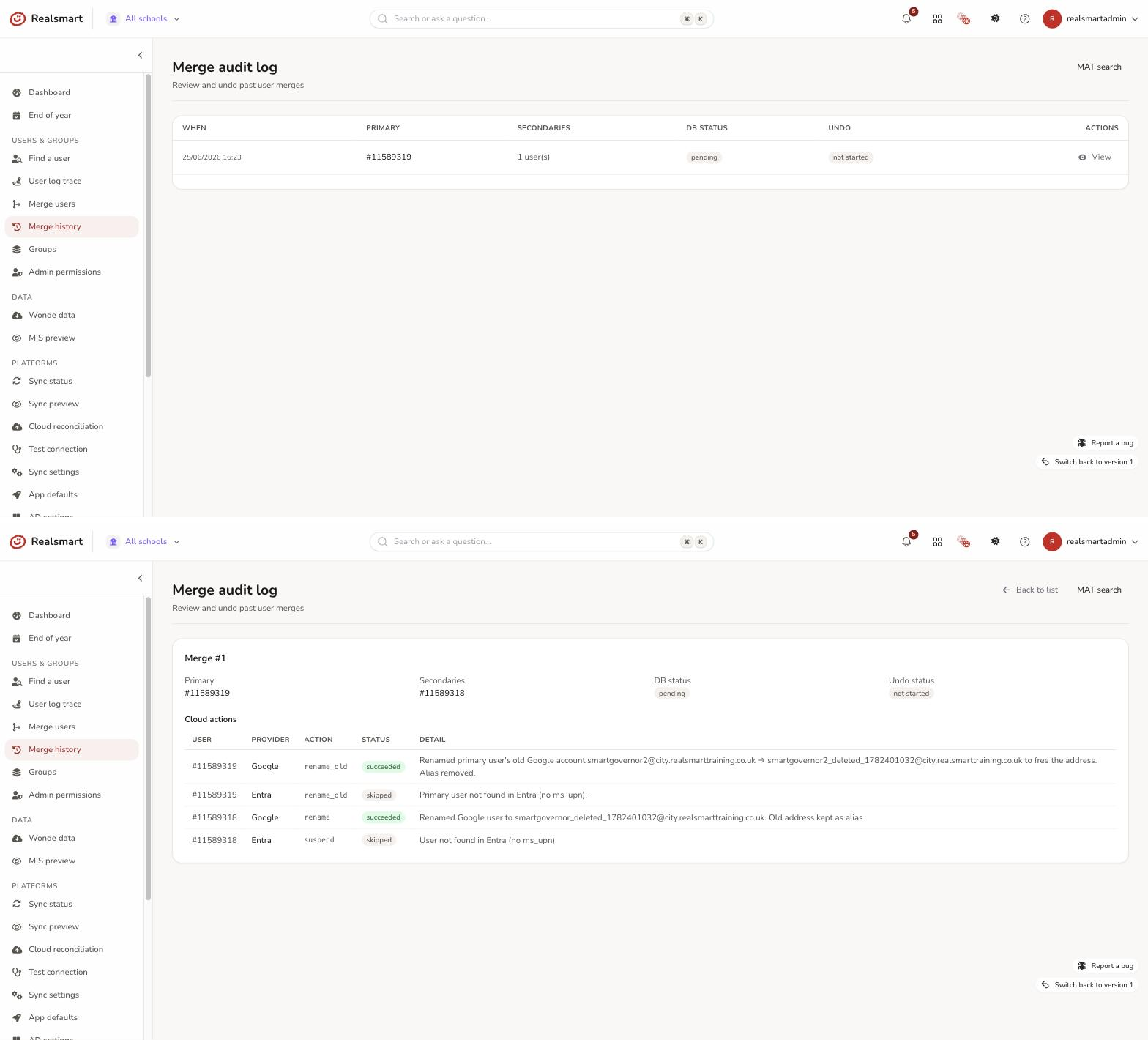
Step 3: View a merge's detail
The detail screen shows the primary and secondary account IDs, the DB and undo status, and a Cloud actions table — every cloud-platform action the merge triggered, with:
- User — which account (by ID) the action applied to
- Provider — Google or Entra
- Action — what was done (e.g. rename, suspend)
- Status — succeeded or failed
- Detail — an error message if it failed
Step 4: Start the undo wizard
If the merge's DB status is completed and its undo status is not started, an Undo this merge button appears (on the list row or the detail screen). Selecting it opens the undo wizard.
If the merge can't be undone automatically — for example the primary account no longer exists, or the original merge never fully completed — the wizard tells you so immediately and stops there.
Step 5: Choose which cloud actions to reverse
For every reversible cloud action from the original merge, choose:
- Reverse — attempt to undo that specific cloud action (e.g. rename the account back)
- Leave — leave the cloud account as the merge left it, and only undo the database change
If undoing would recreate a username that's now taken by someone else, a username conflicts warning lists the clash so you can resolve it first. If the original merge made no reversible cloud changes, the wizard says so and skips straight to a database-only undo.
Choose Run undo to reverse your selected cloud actions and then restore the database records, or Skip cloud, undo DB only to leave every cloud account untouched and just restore the database.
Step 6: Review the result
The wizard shows a brief "Reversing merge…" spinner, then the result:
- Undo completed — the reversal finished cleanly.
- Undo completed with issues — the database was restored, but one or more steps hit a problem; each issue is listed so you know exactly what still needs manual attention.
Select Back to audit log to return to the list.
Troubleshooting
- "The Undo button isn't showing" — it only appears when DB status is completed and undo status is not started. A merge that's already been undone, or that never fully completed, won't offer it.
- "This merge cannot be undone automatically" — the primary account no longer exists, or the merge didn't complete. There's no automatic path back; you'll need to recreate the affected records manually.
- "The cloud reversal failed" — the database restore still goes ahead (or you can choose to skip the cloud step entirely with Skip cloud, undo DB only). Check the failed action's detail and fix the cloud account by hand if needed.
- "A username conflict is blocking the undo" — someone has taken the username since the merge ran. Rename or move that account out of the way, then retry.
Related
Did this work for you?
If a step looked different on your site, tell us and we'll update the screenshots.
Thanks for your feedback.