End-of-term tidy-up
The tidy-up helps you review the accounts and groups that MIS sync will not remove on its own — the ones marked as protected — so you can decide what to keep and what to remove at the end of the year.
Why these need a human
Protected users and groups are deliberately excluded from automatic removal, so a sync can never delete something important by accident. That safety means they can build up over time — the tidy-up is where you review them intentionally.
Using the tidy-up
From the End of year page, choose Start tidy-up. You'll see the protected users and groups for the active school. For each, you can keep it (no change) or delete it. Deleting is confirmation-gated and attributed to you. The page has two tabs, Protected users and Protected groups; it reopens on the one you used last, and the tab is in the page address (?tab=users or ?tab=groups), so a link you copy opens on it.
Review before you delete
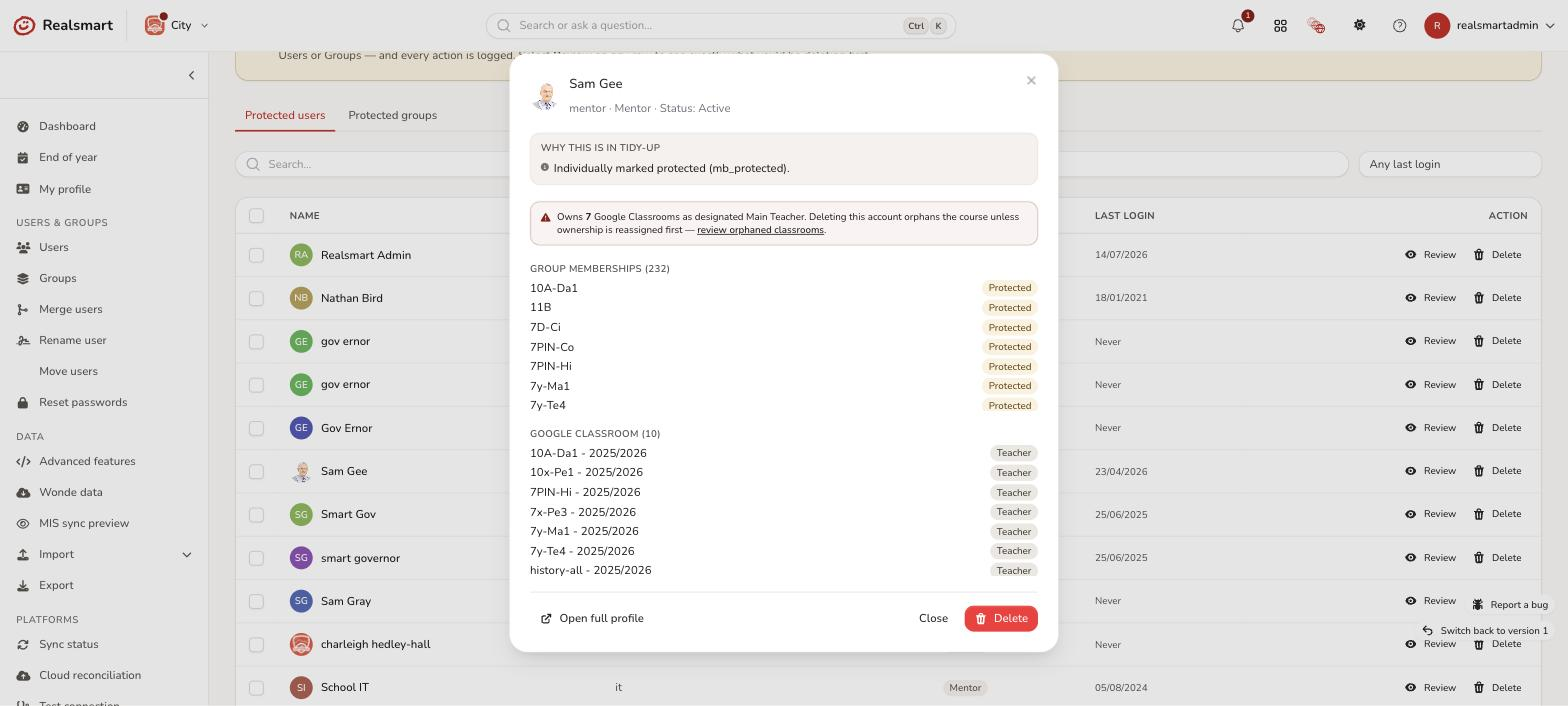
Select Review on any row before deleting it — this is read-only and changes nothing. For a user, you'll see why they qualified for tidy-up (individually protected, status Protected), their group memberships, their synced Google Classroom courses, and — critically — whether they're the designated owner of any Classroom. Deleting a Classroom owner without reassigning it first orphans the course, so this is flagged prominently with a link to orphaned classrooms. For a group, you'll see why it qualified (an auto-managed "teachers of" group, currently empty, every membership itself protected, or "preserve when empty" enabled), its members, and — if it has a linked Classroom — the same ownership diagnostics shown on the group's Classroom tab.
Selecting and deleting in bulk
Tick the header checkbox to select every row on the current page; if there are more matching rows across other pages, you're offered "Select all N matching" to extend the selection, or Clear selection to start over. The selected count is always shown, and you can still tick or untick individual rows afterwards.
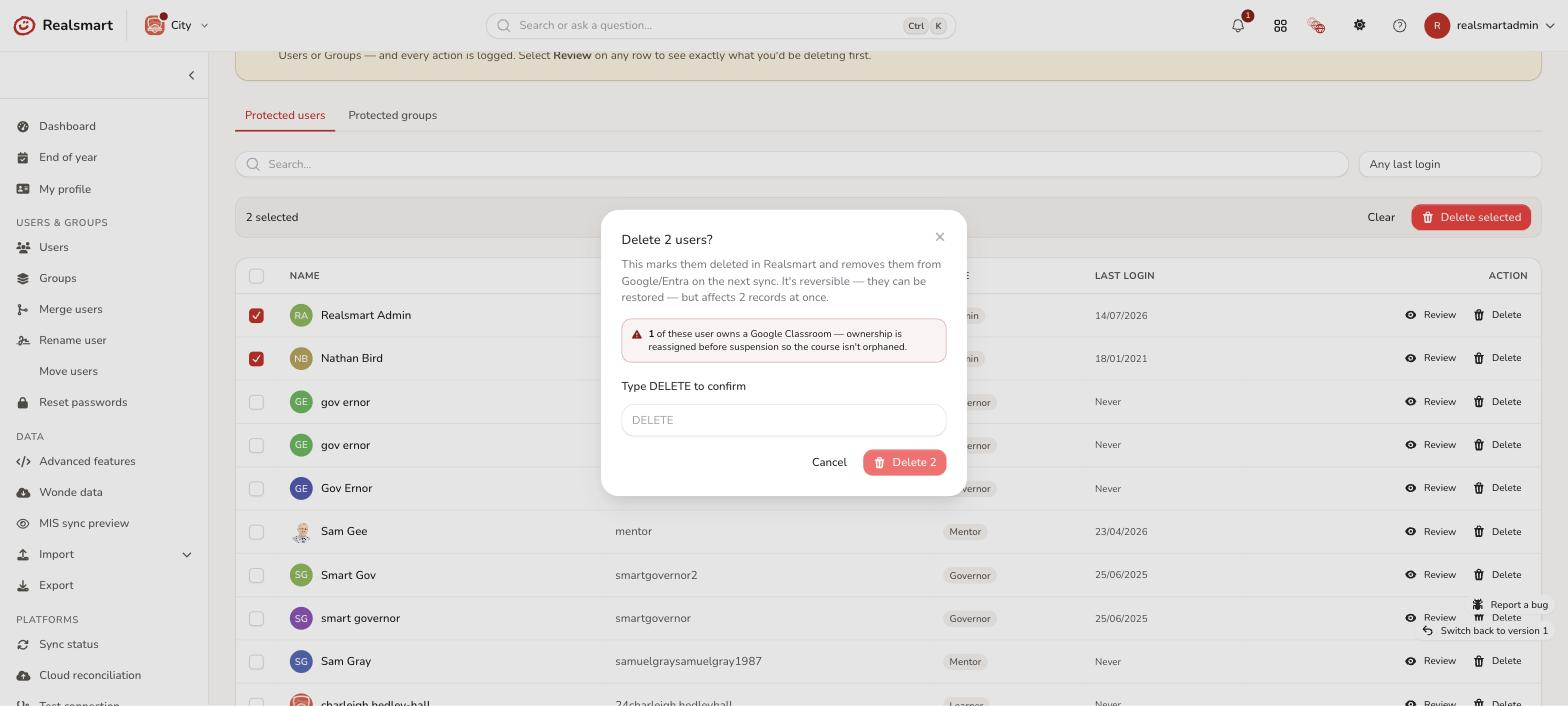
The delete confirmation states exactly what you're about to remove ("Delete 12 users? This cannot be undone" — reversible in practice via restore, but treated as final) and requires typing DELETE to proceed. If any selected users own a Google Classroom (or selected groups have one linked), the confirmation warns you how many, so a bulk delete never silently orphans a course.
When to run it
The natural time is at the end of the year, alongside setting your window and resume date — but you can review at any point. It's per-school and admin-only; nothing is removed automatically.
Was this guide helpful?
We read every response — it decides what we rewrite next.
Thanks for your feedback.